
Kura Oncology Reports Strong Clinical Activity and Safety with Darlifarnib + Adagrasib in KRAS G12C-Mutated Solid Tumors
Kura Oncology Reports Strong Clinical Activity and Safety with Darlifarnib + Adagrasib in KRAS G12C-Mutated Solid Tumors
05-26-2026
– Tumor shrinkage observed in 77% of response-evaluable patients, including in heavily pretreated and KRASi-experienced patients –
– ORRs were 67% in PDAC, 50% in NSCLC, and 29% in KRASi-naïve CRC patients –
– Results reinforce darlifarnib’s potential as a precision combination agent across targeted therapies –
– Clear clinical activity in KRASi-experienced patients and manageable safety profile –
– Virtual investor event on
The combination of darlifarnib plus adagrasib demonstrated meaningful antitumor activity in heavily pretreated pancreatic ductal adenocarcinoma (PDAC) and non-small cell lung cancer (NSCLC) patients with prior KRAS inhibitor (KRASi) exposure, as well as KRASi-naïve colorectal cancer (CRC) patients. These data provide clinical proof-of-mechanism for Kura’s FTI platform as a precision combination that blocks RHEB-dependent mTORC1 signaling, a key resistance pathway shared across multiple targeted therapy classes.
“These results are very encouraging for patients and represent a major milestone for the FTI field,” said
“RAS inhibitors have raised the bar in the treatment of KRAS-mutated cancers, but resistance remains a major limitation of current therapies,” said
Key Highlights (Phase 1a, N=30; 26 response evaluable):
- 77% (20/26) of response-evaluable patients achieved tumor shrinkage, including 94% (15/16) of response-evaluable, KRASi-naïve patients
- Objective response rate (ORR): 67% in PDAC, 50% in NSCLC, and 29% in KRASi-naïve CRC
- Responses were observed across dose levels and tumor types
- Clinical activity observed in heavily pre-treated patients, including those with prior KRASi exposure
- In NSCLC, confirmed partial response and 84% target lesion reduction observed in a patient previously treated with a KRAS inhibitor
- Median follow-up time (range): PDAC 6.7 (4.0-10.4) months; NSCLC 6.9 (3.2-11.8) months;
CRC 8.9 (1.2-13.2) months - 37% of patients remained on study treatment at time of data cutoff (
March 25, 2026 ) - Combination was well tolerated with a manageable safety profile
Best Percent Change in Target Lesion Size: PDAC, NSCLC and CRC
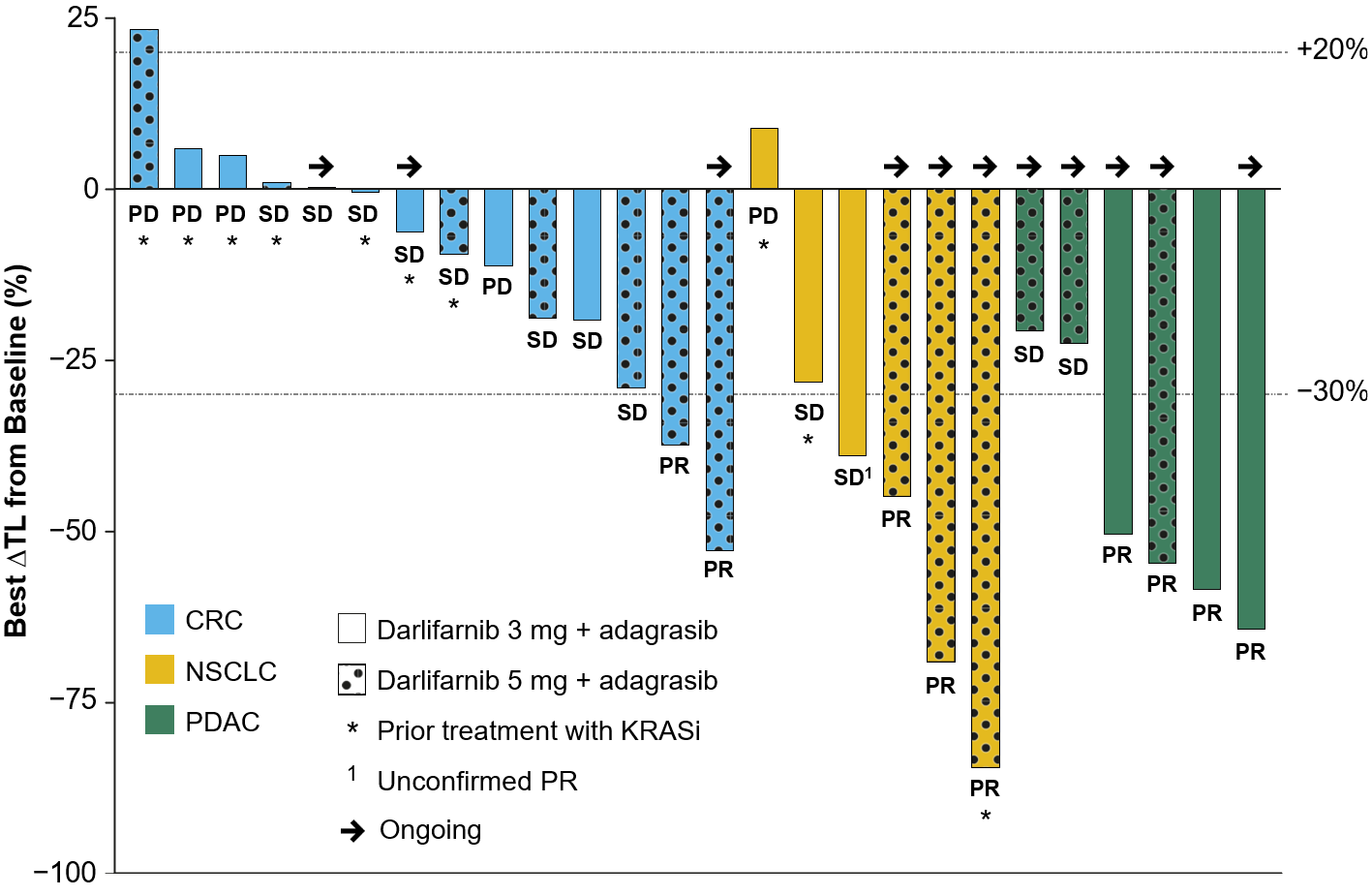
The waterfall plot shows best percent change from baseline in target lesion size among response-evaluable patients. Objective responses were observed across all three tumor types and dose levels. Bars that extend below the -30% horizontal line indicate target lesion reductions meeting the RECIST threshold for response, and all PRs represent confirmed partial responses.
Darlifarnib is designed to address resistance across multiple targeted therapies by inhibiting RHEB farnesylation, resulting in a sustained blockade of mTORC1 signaling and enhancing anti-tumor activity of RAS inhibitors. In pre-clinical models, darlifarnib enhances anti-tumor activity of RAS inhibitors in NSCLC and CRC.
Patients were administered darlifarnib 3 mg, 5 mg, or 8 mg once daily on days 1-7 and 15-21 of each 28-day cycle in combination with adagrasib 400 mg twice daily. The darlifarnib 8 mg dose will not be advanced for further evaluation in the darlifarnib and adagrasib combination.
The full ASCO presentation will be available starting
Virtual Investor Event
Kura will host a webcast and conference call on
About the FIT-001 Trial
FIT-001 (NCT06026410) is a Phase 1 clinical trial evaluating darlifarnib (KO-2806) as a monotherapy and in combination with targeted therapies in patients with advanced solid tumors. The trial includes an escalation cohort of patients with RAS-altered advanced solid tumors, as well as dose escalation and dose optimization cohorts evaluating darlifarnib with cabozantinib in advanced renal cell carcinoma, and with adagrasib in KRAS G12C-mutant advanced PDAC, NSCLC, and CRC.
About Kura Oncology
Kura Oncology is a biopharmaceutical company committed to realizing the promise of precision medicines for the treatment of cancer. Kura’s pipeline of small molecule drug candidates is designed to target cancer signaling pathways and address high-need hematologic malignancies and solid tumors. Kura developed and is commercializing KOMZIFTI™ (ziftomenib), the FDA-approved once-daily, oral menin inhibitor for the treatment of adults with relapsed or refractory NPM1-mutated acute myeloid leukemia, and continues to pioneer advancements in menin inhibition and farnesyl transferase inhibition. For additional information, please visit the Kura website at https://kuraoncology.com/ and follow us on X and LinkedIn.
Forward-Looking Statements
This news release contains certain forward-looking statements that involve risks and uncertainties that could cause actual results to be materially different from historical results or from any future results expressed or implied by such forward-looking statements. Such forward-looking statements include, among other things, statements regarding darlifarnib’s potential as a combination partner for KRAS inhibitors and a broad range of other precision therapies and the potential of combining darlifarnib with adagrasib to deepen and extend responses. Factors that may cause actual results to differ materially include the risk that compounds that appeared promising in early research or clinical trials do not demonstrate safety and/or efficacy in later preclinical studies or clinical trials, the risk that Kura may not obtain approval to market its product candidates, uncertainties associated with performing clinical trials, regulatory filings, and other interactions with regulatory bodies, and other risks associated with the process of discovering, developing and commercializing drugs that are safe and effective for use as human therapeutics, and in the endeavor of building a business around such drugs. You are urged to consider statements that include the words “may,” “will,” “would,” “could,” “should,” “believes,” “estimates,” “projects,” “promise,” “potential,” “expects,” “plans,” “anticipates,” “intends,” “continues,” “designed,” “goal,” or the negative of those words or other comparable words to be uncertain and forward-looking. For a further list and description of the risks and uncertainties Kura faces, please refer to Kura’s periodic and other filings with the Securities and Exchange Commission, which are available at www.sec.gov. Such forward-looking statements are current only as of the date they are made, and Kura assumes no obligation to update any forward-looking statements, whether as a result of new information, future events or otherwise.
Conflict of Interest Disclosure
Dr. Hong’s disclosures include consulting, speaker or advisory roles with Abbvie, Acuta, Alpha Insights, Amgen, Axiom, Blueprint, Beigene,
Kura Contact
Investors and Media:
858-987-4046
gmann@kuraoncology.com
A photo accompanying this announcement is available at https://www.globenewswire.com/NewsRoom/AttachmentNg/52aa1f06-6701-4a4b-950a-526765c4f974

Best Percent Change in Target Lesion Size: PDAC, NSCLC and CRC

The waterfall plot shows best percent change from baseline in target lesion size among response-evaluable patients. Objective responses were observed across all three tumor types and dose levels. Bars that extend below the -30% horizontal line indicate target lesion reductions meeting the RECIST threshold for response, and all PRs represent confirmed partial responses.
Source: Kura Oncology, Inc.